UAV Opens Up New “Flight Routes” for Agricultural Products in Dien Bien’s Highland Areas
From hilly areas and hard-to-access locations, coffee, macadamia nuts, tea and other agricultural products in Dien Bien now have an additional means of transport using unmanned aerial vehicles (UAVs). In addition to supporting the transportation of agricultural products from harvesting sites to collection points, UAVs are also being tested for seed sowing, pesticide spraying, fertilizer application and the transportation of agricultural supplies. The initiative offers an additional solution to reduce transportation time and costs, minimize post-harvest losses and help people in highland areas improve production efficiency.
Implementing Decision No. 1291/QD-UBND dated June 23, 2026, of the Dien Bien Provincial People’s Committee on granting controlled pilot approval for digital technology products and services for low-altitude economic development using UAVs, the Department of Science and Technology has coordinated with Vietnam Post Corporation (Vietnam Post), FPT Group and relevant agencies and units to implement the model across the province.
One of the first activities has been the use of UAVs to transport goods and agricultural products in Muong Ang. Since September 21, 2026, Vietnam Post has used UAVs to transport agricultural products, initially covering the route from harvesting sites to collection points. Coffee and macadamia nuts from hard-to-access hilly areas can be transported by UAVs with a payload of up to 50 kg per flight, before being transported by road to cooperatives and purchasing and processing facilities.
For farmers, cooperatives and production facilities in areas with difficult terrain, having an additional means of transport from harvesting areas to collection points can shorten one stage in the process of moving agricultural products out of production areas. This is also one of the model’s objectives, aiming to reduce transportation time and costs and minimize post-harvest losses for products such as tea, macadamia nuts and coffee.
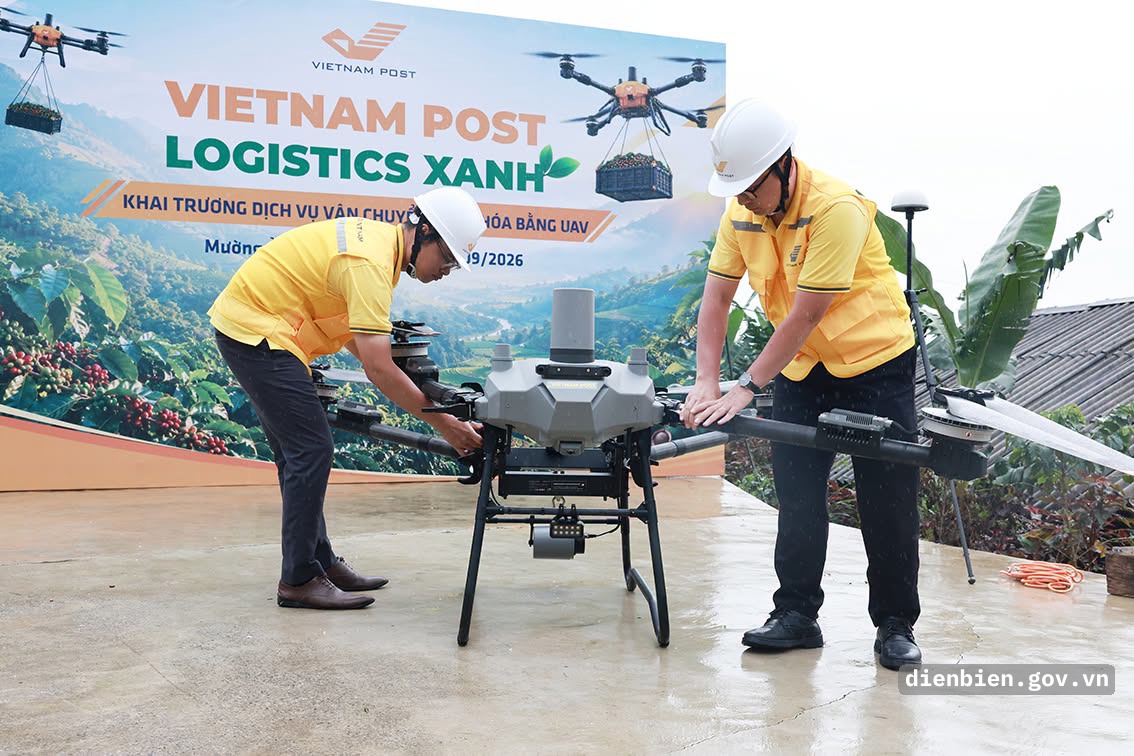
Vietnam Post uses UAVs to support agriculture in Muong Ang Commune (Photo: VNP)
According to the plan, Phase 1, from September to the end of December 2026, will focus on transportation, pesticide spraying and rice seed sowing in the Ta Phin – Ta Pao tea forest area in Sinh Phinh Commune; the Muong Thanh Field; and Thanh Nua, Tuan Giao and Muong Ang communes. This phase focuses on bringing UAVs into operations directly serving agricultural production. Support for seed sowing, pesticide spraying and transportation provides additional options for farmers and cooperatives in organizing production, particularly in areas where difficult terrain makes access by conventional means challenging.
In Phase 2, from January to March 2027, the model will be expanded to pesticide spraying, fertilizer application and transportation in macadamia-growing areas in Tuan Giao and coffee-growing areas in Muong Ang. It will also continue to be implemented in Muong Thanh Field, with priority given to Thanh Nua and Sinh Phinh communes. The use of UAVs in various cultivation and transportation activities is expected to help reduce production time and costs while supporting people in handling work in scattered production areas with difficult access.
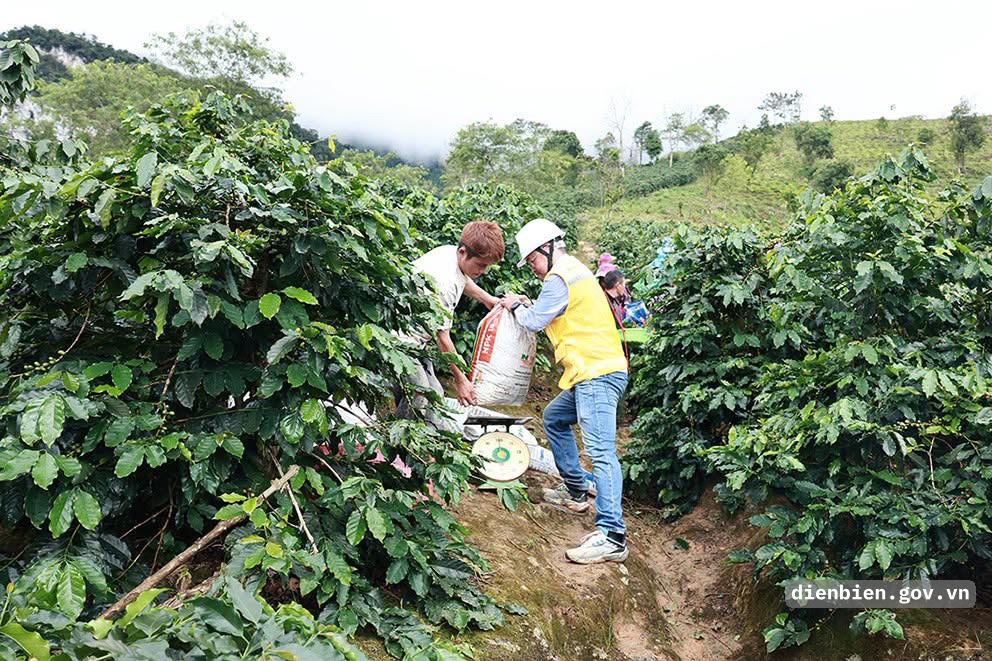
Coffee, macadamia nuts and other products from hard-to-access hilly areas can be transported by UAVs with a payload of up to 50 kg per flight (Photo: VNP)
Phase 3, from April to June 2027, will further expand the pilot scope. UAVs will be used to transport medicines, medical supplies and test samples from Muong Ang Medical Center to four medical stations and satellite medical station points in Na Tau, Ang To, Muong Dang and Ngoi Cay. During the same period, the model will continue transporting coffee, macadamia nuts and fresh tea during the peak harvest season in Tuan Giao, Sinh Phinh and Muong Ang.
For people in remote and isolated areas, the benefits of UAVs extend beyond agriculture. The technology is also being tested to support the delivery of medicines, medical supplies and test samples to medical facilities, helping ensure timely and safe supplies for medical examination and treatment as well as disease prevention and control.
In Phase 4, from July 2027 through the end of the second quarter of 2028, the model will move from pilot testing to expansion, operation and investment promotion. The total number of flights expected throughout the program is approximately 6,000.
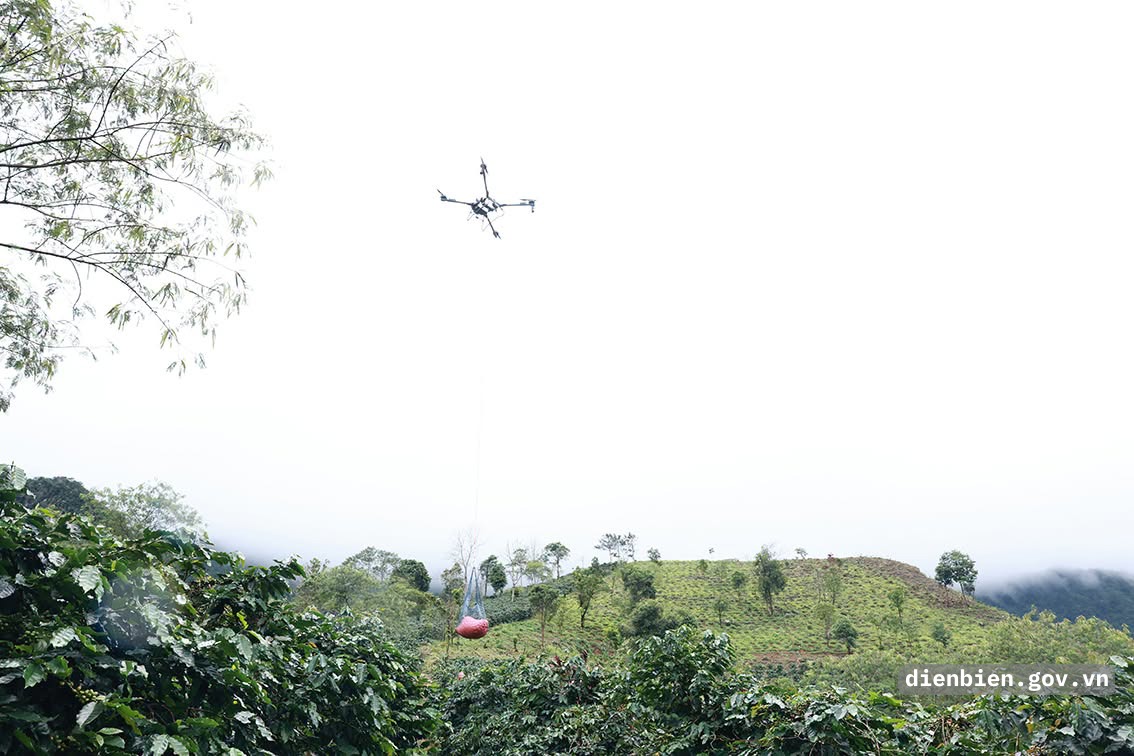
Initially, UAVs are being used to transport goods and agricultural products from harvesting sites to collection points (Photo: VNP)
UAVs are not simply being deployed as a technology experiment but are being integrated into specific production and daily-life needs. In particular, the agricultural product transportation model in Muong Ang demonstrates how UAVs can be integrated with existing transport methods. UAVs handle the route from harvesting sites to collection points, after which the agricultural products continue by road to cooperatives and purchasing and processing facilities.
With a payload of up to 50 kg per flight, this method provides an additional option for collecting agricultural products from hard-to-access hilly areas. To ensure that the model is implemented as intended, the Department of Science and Technology encourages organizations and individuals interested in applying UAV technology to visit, experience and conduct practical trials. Businesses, cooperatives and organizations interested in the model are also encouraged to explore the potential applications of UAVs in agriculture, healthcare, logistics, tourism, trade, digital technology and resource management.
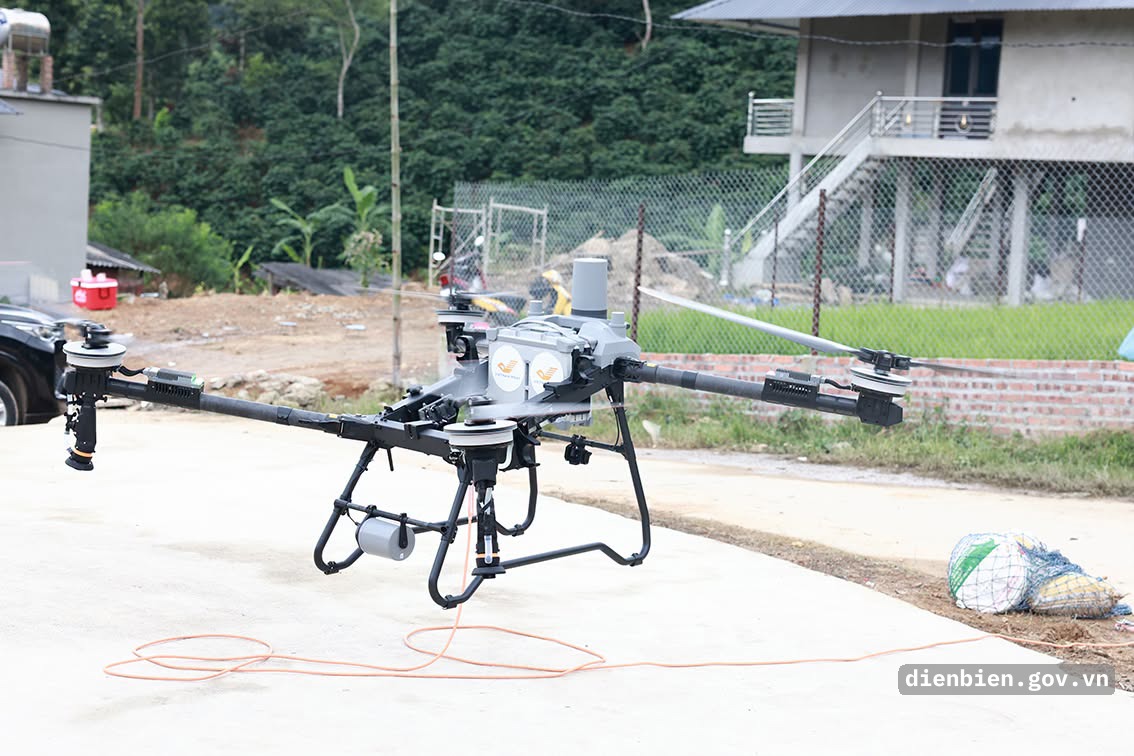
Having an additional means of transport from harvesting areas to collection points can shorten one stage in the process of moving agricultural products out of production areas (Photo: VNP)
From the first pilot flights, UAVs are being introduced into practical aspects of production and daily life in Dien Bien. In agriculture, the focus is on reducing transportation time and costs, minimizing losses and making it easier for people to access remote production areas. For people in remote and isolated areas, the technology is also being tested to deliver medicines, medical supplies and test samples to medical facilities.
The pilot program of approximately 6,000 flights will provide a basis for Dien Bien to assess practical effectiveness, identify suitable fields of application, gradually refine the model and move toward expanded operations and investment promotion in the next phase.
Vietnam Post’s launch of UAV-based goods and agricultural product transportation services in Dien Bien demonstrates how science, technology and innovation can be applied to address practical challenges in daily life and production. The initiative also contributes to concretizing the spirit of Politburo Resolution No. 57-NQ/TW on breakthroughs in the development of science, technology, innovation and national digital transformation, which identifies science, technology, innovation and digital transformation as important drivers of local socio-economic development./.